
Qu’est-ce que la conscience de soi ?
🔥 Produits recommandés : Canon EOS R6 II • DJI Mini 4 Pro • MacBook Pro M4
Il s’avère que la conscience de soi peut signifier beaucoup de choses différentes, selon la personne à qui l’on s’adresse.
Dans cet article, nous examinerons la véritable signification de la conscience de soi, pourquoi elle est si importante pour chacun d’entre nous, et ce que vous pouvez faire pour améliorer votre conscience de soi afin de vivre une vie heureuse et réussie.
Table des matières
Qu’est-ce que la conscience de soi ?
La connaissance de soi peut être aussi simple que d’entrer en contact avec ses pensées et ses sentiments, puis de les comprendre. Pour certains, il peut s’agir de se connecter à ses croyances et valeurs les plus profondes, puis de vivre une vie en accord avec ces valeurs.
Pour les personnes qui se concentrent davantage sur le développement professionnel, la connaissance de soi consiste à comprendre ses forces, ses faiblesses, ses types de personnalité et ses styles de leadership.
Selon le dictionnaire de Google, la conscience de soi est :
« Connaissance consciente de son propre caractère, de ses sentiments, de ses motivations et de ses désirs.
Selon Psychology Today, la conscience de soi :[1]
« implique de surveiller nos mondes intérieurs, nos pensées, nos émotions et nos croyances. C’est important, car c’est un mécanisme majeur qui influence le développement personnel ».
Depuis la publication de son livre, Emotional Intelligence , en 1995, l’idée de Daniel Goleman sur l’intelligence émotionnelle (alias QE ou IE) et la conscience de soi a pris le monde d’assaut. Comme vous pouvez le constater, il existe un large éventail de significations, de définitions et d’interprétations.
Les deux questions les plus importantes, à mon avis, sont les suivantes : 1) Pourquoi la conscience de soi est-elle si importante et 2) Comment pouvons-nous devenir plus conscients de nous-mêmes dans notre vie ?
Ce sont les deux questions sur lesquelles nous allons nous pencher aujourd’hui.
Pourquoi la conscience de soi est-elle importante ?
Dans une étude réalisée par Green Peak Partners et l’université de Cornell, 72 cadres d’entreprises publiques et privées dont le chiffre d’affaires allait de 50 millions de dollars à 5 milliards de dollars ont été étudiés. Voici ce que l’étude a révélé :[2]
« Les cadres les plus susceptibles d’obtenir de bons résultats sont en fait des leaders conscients d’eux-mêmes qui sont particulièrement doués pour travailler avec des individus et en équipe. L’étude poursuit en affirmant qu' »un score élevé de conscience de soi est le meilleur prédicteur de la réussite globale ».
Et voilà !
Une meilleure connaissance de soi est synonyme d’une plus grande réussite. Mais cela va au-delà de notre vie professionnelle – cela s’applique également à notre vie personnelle.
Dans son livre Emotional Intelligence, Goleman considère l’intelligence émotionnelle comme un facteur essentiel de réussite, en particulier pour les enfants. Il a proposé que l’intelligence émotionnelle n’améliore pas seulement leurs capacités d’apprentissage, mais qu’elle les aide également à réussir à l’école en réduisant ou en éliminant certains des problèmes de comportement les plus distrayants et les plus nocifs[3].
Depuis 1995, d’innombrables études ont été menées sur la conscience de soi et le QE dans son ensemble. Certaines ont montré qu’un meilleur QE pouvait aider les étudiants à réussir, tant sur le plan académique que social.
D’autres études ont montré que la conscience de soi peut améliorer la communication et réduire les conflits dans les relations, en particulier dans les couples mariés[4].
En vous plongeant dans la recherche en ligne, vous découvrirez que la conscience de soi influe sur tout ce que vous faites. Elle affecte votre leadership, vos relations, la manière dont vous traitez les autres, votre communication, ce que vous attendez des gens, la manière dont vous réagissez aux situations, et bien d’autres choses encore.
La conscience de soi est, sans aucun doute, une compétence essentielle que chacun devrait s’efforcer d’améliorer.
Et voici la bonne nouvelle ! La conscience de soi s’apprend.
En 2009, Delphine Nelis et ses collègues ont mené une expérience contrôlée pour vérifier s’il était possible d’accroître l’intelligence émotionnelle.
Les participants du groupe expérimental ont reçu une brève formation à l’IE d’origine empirique, tandis que les participants du groupe témoin ont continué à vivre normalement. À la fin de l’expérience, ils ont prouvé qu’il était possible d’améliorer l’intelligence émotionnelle[5].
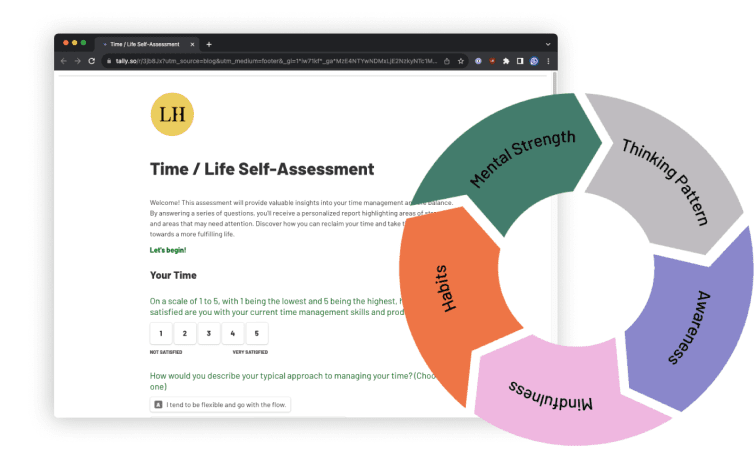
Votre vie est-elle équilibrée ?
Assess how balanced your life is with our Time/Life Self-Assessment and get a customized report for free.
You will find out your time management strengths, uncover hidden opportunities, and shape your life on your terms.
How to Become More Self-Aware
If I’ve done my job correctly, you should be 100 percent sold on the importance of self-awareness, and you should be hungry to know how to improve on this area of your life.
That’s great because I have six strategies to help you do just that.
1. Create Space for Yourself
Have you ever heard the saying, “You can’t see the forest for the trees?”
Sometimes, when we have our heads down, and we’re immersed in our everyday lives, it’s hard to see what’s really going on. Life is busy, so if you want to become more self-aware, you have to create space for yourself.
I don’t necessarily mean a meditation room, although that might help.
What I mean is, you need to carve out time in your day to reflect on your life:
How are you feeling?
Are you stressed, worried, or upset? Are you filled with joy and passion? Or, are you somewhere in between? It’s important to touch base with your feelings every day; otherwise your feelings can build and emerge in unpleasant ways.
What are you thinking about?
Do you have big problems but no time to think of solutions? Could things be going better in certain areas of your life?
What are you focused on?
What is getting the most of your time? Should that thing or those people be getting so much of your time? Are you drifting through life, or are you attacking your life plan with passion and energy?
Most people are far too busy running through the motions of everyday life that they forget to pause and reflect. But not you! You’re on a quest to become more self-aware.
Maybe you can reflect during an early morning walk or meditation. Perhaps you could reflect during an hour in the gym, on the treadmill, or on a hiking trail.
It really doesn’t matter where you create the space for yourself—all that matter is that you make the time.
I’ve tried meditation, and it doesn’t work for me. Instead, I tend to check in with myself the most while I’m mowing the lawn, jogging, lifting weights, or journaling. Those are the times it happens naturally for me. There’s just something about being engaged in repetitive activity that clears my mind.
Find what works for you and create some space in your life. You need it!
2. Practice Mindfulness
For me, this is a tough one!
Google’s Dictionary defines mindfulness as “a mental state achieved by focusing one’s awareness on the present moment, while calmly acknowledging and accepting one’s feelings, thoughts, and bodily sensations.”
I’m bad about moving through life at hyper speed, fueled by copious amounts of coffee while trying to crush my goals as quickly as possible. Stopping to smell the roses every once in a while is just plain hard for me.
It’s easy to be so future-focused that you lose track of the present, but by creating space in our lives, we essentially carve out dedicated times to practice mindfulness.
During these times, it’s important to listen to your inner voice, tune into what you’re feeling and why you’re feeling it, and to acknowledge and understand yourself better.
How many times have you been upset and had no idea why?
This has happened to me, but then later on, when my mind became clear, it was easy to see why I was upset and what I needed to do about the situation. But we can’t always wait until our mind clears on its own!
In today’s fast-paced environment, the time may never come on its own. We have to make time for it.
Find some space in your life and use it to practice mindfulness each day. Here’s a beginner guide to try: Meditation Can Change Your Life: The Power of Mindfulness
3. Keep a Journal
What better way to create some space for yourself and practice mindfulness than to develop a daily journaling habit?
According to Psych Central,[6]
“The act of writing accesses your left brain, which is analytical and rational. […] In sum, writing removes mental blocks and allows you to use all of your brainpower to better understand yourself, others and the world around you.”
I had no idea! Did you?
In addition to that, journaling can help you clarify your thoughts and feelings, get to know yourself better, reduce overall stress, solve problems more effectively, and even resolve disagreements with others.
If it helps, think of journaling as practicing mindfulness on paper.
Take some quiet time to think about your inner world, how you’re feeling, what you’re thinking, and so on. While you’re analyzing your inner world, write down all of your thoughts as they occur to you. I call this a stream of consciousness.
If you can, do this at least once a day, either in the morning or in the evening. If you want to take your self-awareness to an even higher level, try journaling your observations every hour throughout the day.
According to the National Science Foundation, we have an average of 50,000 thoughts per day, most of which we are not self-aware enough to notice.[7] Imagine if you took a little time to practice mindfulness and wrote some of those thoughts down.
4. Become an Excellent Listener
Stephen R. Covey, the author of the Seven Habits of Highly Effective People, once said,
“Most people do not listen with the intent to understand; they listen with the intent to reply.”
Do you fall into that category?
For the longest time, I absolutely did. As people were talking to me, I was trying to hold onto as many of my own thoughts, replies, and rebuttals as possible. Then, moments later, I couldn’t recall a single thing I had been told.
A couple of years ago, I became aware of this phenomenon when I read John Maxwell’s Becoming a Person of Influence. There was an entire chapter on listening, and I learned that I was a terrible listener!
When you stop to listen to someone, your goal is to do a lot more than just hear their words better—you need to observe their tone, their body language, their emotions, and their attitude. You need to become acutely aware of how they feel and how you’re making them feel.
Instead of evaluating and judging what the other person is saying, connect with them, and listen and observe what they have to say. As you become a better listener to those around you, you will learn to listen to your inner voice better as well.
5. Seek New Perspectives About Yourself
Most of us think we have ourselves pretty figured out, don’t we? We spend more time with ourselves than with anyone else. We know all of our own intimate secrets, hopes, dreams, and guilty pleasures.
How could we not know ourselves inside and out? Well, I would argue that it’s tough to honestly know ourselves, at least entirely.
Here’s why:
I think we often know ourselves as the person we aspire to be, not the person we are in the present.
My favorite show of all time is NBC’s The Office. In one episode, Michael Scott is introducing a new salesman to the staff. The new salesman is highly skilled, attractive, charming, and so on. Michael says this to his team:[8]
“I respect him, because he reminds me of somebody. Can anybody guess who that is?”
The staff takes their round of incorrect guesses, and Michael responds, “No, me. Right? Sorta like, a little younger version of me?”
In his eyes, he and the new guy were very similar, but Oscar replies, “It’s hard to judge ourselves accurately isn’t it.”
Oscar sees Michael through a completely different lens than Michael sees himself. And if you’ve seen the show, Oscar’s perspective is dead on.
It’s difficult to get pure, honest feedback free of bias and fluff, but by asking our friends, family, and coworkers for 360-degree feedback, we can gain a new perspective about ourselves that would be challenging to get on our own.
If you want to become truly self-aware, seek feedback from those you know and trust. The insights may surprise you, but the new perspective will be incredibly valuable.
6. Live and Breathe Personal Development
The last strategy I’ll leave you with for increasing your self-awareness is to consume as much personal development content as you can.
I love to listen to podcasts, watch YouTube videos, read books and blogs about leadership, mentorship, goal setting, high performance, building good habits, and so on. The more I dive into personal development, the more I learn about myself.
A year ago, I didn’t know about scarcity mindset or risk aversion, let alone that I suffered from both. Now that I know I suffer from these things, I can work towards overcoming them in my life.
The more you learn about the world around you, the better you can begin to understand yourself, and that’s why self-awareness is so incredibly critical to success.
Final Thoughts
The impact that self awareness has on success is undeniable, but mastering self-awareness is going to take some effort from you. Are you up for it? I think you are!
You’ve got this!
More Tips for Increasing Self Awareness
- Why Self Actualization Matters More Than Anything Else
- The Importance of Self Improvement No Matter How Old You Are
- How to Build Self Esteem (A Guide to Realize Your Hidden Power)
- Signs Of Low Self-Esteem And The Root Causes You Might Not Know
Featured photo credit: Priscilla Du Preez via unsplash.com