
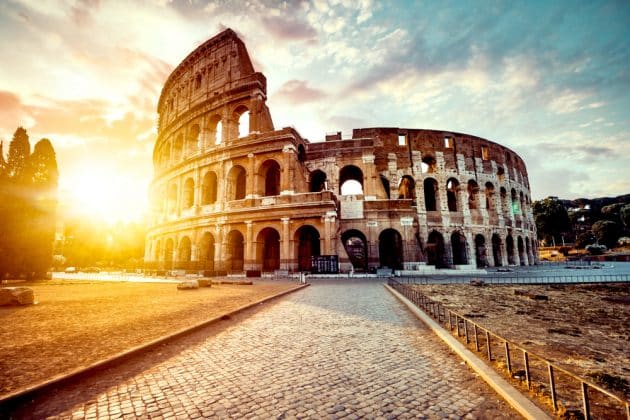
Italy, like Greece, is a land steeped in legend, myth and history. Today, these stories are told through its most beautiful archaeological sites.
Whether in Greek, Roman or Ottoman times, Italy has always been at the center of history. A history full of legends and drama, which has been revealed to us since the 17th century and the first archaeological discoveries.
Since then, excavations have never ceased to fascinate us all. From gladiatorial combat in the center of Rome’s Colosseum to the buried city of Pompeii, each archaeological site helps us to better understand the history of civilization.
That’s why Generation Voyage offers you a guided tour of Italy’s 12 most important archaeological sites.
Squares and cities
Pompeii, the ruins of a tragic history

Ruins of the city of Pompeii, with a view of Mount Vesuvius – Photo credit: Shutterstock – Darryl Brooks & Karl Allen Lugmayer
Conservation status : ★★★★★
Public knowledge : ★★★★★
Historical influence : ★★★★★
How could we not begin this journey in the footsteps of history with the world’s most famous archaeological city: Pompeii? Wrecked by Vesuvius in 79 AD, Pompeii is today the only archaeological site in Italy offering a complete overview of ancient Roman cities.
A Unesco World Heritage site, Pompeii reveals dwellings with mural decorations that are sometimes intact, alleys of commercial buildings and cobblestone streets linking the whole city in total harmony.
The (re)discovery of this city in the 17th century has since improved worldwide archaeological practice, historical understanding of Roman civilizations and knowledge of ancient art. For all these reasons, Pompeii is the most influential archaeological site in Roman history, and a must-see.
Herculaneum, the other buried one

Fresco and ruins at Herculaneum – Photo credit: Shutterstock – Pierrette Guertin & Abrilla
Conservation status : ★★★★★
Public knowledge: ★★★
Historical influence: ★★★★
Herculaneum, less well known than its « big sister Pompeii, is the other city buried by the infamous eruption of Mount Vesuvius in 79. Smaller than Pompeii, and above all less well known, Herculaneum nonetheless offers an equally impressive archaeological site.
Once there, you can explore the port area, where over 300 human skeletons have been discovered. You’ll also find the Sacellum des Augustales, as well as the houses of Neptune and Amphitrite, where you can admire their particularly well-preserved mosaics.
To visit this archaeological site in Italy, you should allow around two hours. We recommend that you be accompanied by a guide, who will take you on a journey through time and history.
The Roman Forum, the heart of history

The Roman Forum, ancient remains in the heart of Rome – Photo credit: Shutterstock – tichr & Ava Peattie
Conservation status: ★★★
Public knowledge: ★★★★
Historical influence: ★★★★★
A visit to the Roman Forum places you at the heart of history. Established on a marshy area drained and reclaimed for its construction, the Roman Forum quickly became the main square of Ancient Rome. Religious ceremonies, games, gladiatorial fights and political proclamations were held here until the fall of the Roman Empire in the 5th century.
On site, you’ll discover the temples of Divo Giulio (Caesar’s temple), Saturn and the Dioscuri, as well as the columns of Phocas and the Basilica Æmilia. All these discoveries have enabled us to refine our vision of life in Rome at the height of Antiquity.
This Italian archaeological site, also known as the « cow field » because it was used for grazing in the Middle Ages, has been a landmark for archaeologists since the 18th century.
Theaters and arenas
Rome’s inexhaustible Colosseum

Rome’s Colosseum – Photo credit: Shutterstock – JPF & Viacheslav Lopatin
Conservation status : ★★★★
Public knowledge : ★★★★★
Historical influence : ★★★★★
Along with Pompeii, Rome’ s Colosseum is Italy’s best-known major historical site. An ovoid amphitheatre built between 71 and 80 A.D., it is a veritable legend in the collective imagination. Until the end of the 6th century, it witnessed Roman extravagance (and cruelty).
Over 50,000 people flocked to see wild animal fights, gladiatorial combat, battle re-enactments celebrating the glory of the Roman Empire, and executions of condemned criminals.
As you explore the ruins of the Colosseum, you’ll discover its history. The history of a place that survived earthquakes, the fall of the Roman Empire and many other trials. Discover an architecture unique for its time, step into the arena and imagine yourself a gladiator facing the emperor, or soak up the singular atmosphere of the Colosseum’s basements, where so many legends are eternally whispered.
Taormina Theatre

Taormina theater, view of Mount Etna – Photo credit: Shutterstock – michelangeloop & Raisa Suprun
Conservation status : ★★★★
Public knowledge: ★★
Historical influence: ★★★
The Theater of Taormina is one of the oldest remains of the Greco-Roman era, and the largest theater in ancient Italy (along with that of Syracuse). Dating from the 3rd century BC, it is particularly well located: in the ancient Greek and then Roman city of Tauromenion (now Taormina). On the side of a hill, it offers an extraordinary view of the Mediterranean and MountEtna.
Its architecture, more the result of Roman renovations than of the original Greek construction, is notable for its arched tiers facing the stage.
Verona Arena

Verona’s 30,000-seat Arena – Photo credit: Shutterstock – mikolajn & Andrea Berg
Conservation status : ★★★★
Public knowledge: ★★★
Historical influence: ★★★
With over 2,000 years of history and performances, the Arena of Verona is without doubt the most fascinating Italian archaeological site in the Veneto region. Built around 30 A.D., they were then used, like the Colosseum, to host spectacular performances to entertain the populace.
Partly destroyed by an earthquake in the early 12th century, it was French general Sextius Alexandre François de Miollis who organized the renovation during the First Empire.
Since then, the arena has never ceased to host opera performances and, above all, re-enactments of gladiatorial combat, which you can admire almost every evening from March to September. As a symbol, the arena will host the closing ceremony of the 2026 Winter Olympics.
Archaeological complexes
Neapolis National Park

Ruins of a Greek theater, and « Ear of Denys » in Neapolis National Park – Photo credit: Shutterstock – Fotokon
Conservation status: ★★★
Public knowledge: ★★
Historical influence: ★★★
Back to Sicily, to the Archaeological Park of Neapolis! Here, a multitude of sites follow one another, dating from both Greek and Roman times, in varying states of preservation. Greek theater, Roman amphitheater, Hieron II altar and Latomies follow one another, offering a glimpse into history like few other archaeological sites in Italy.
What’s more, the Greek theater, built some 500 years before the Roman amphitheater, is much better preserved. For this archaeological site, the presence of a guide will ensure that you don’t miss a single detail, and mythology buffs will be told the story of « the ear of Denys », the tyrant who came to listen to the conversations of the prisoners in these Latomies.
Paestum Archaeological Park

Temple of Hera and Temple of Neptune, Paestum – Photo credit: Shutterstock – Stefano Buttafoco & canadastock
Conservation status : ★★★★
Public knowledge: ★★
Historical influence: ★★
Originally a Greek colony founded in 600 B.C., Paestum is now a UNESCO World Heritage-listed archaeological park located on the southeastern Gulf of Salerno. Named Poseidonia at the time, the colony paid homage to the Greek gods.
Although the city’s history became Roman in 273 BC, it’s the Greek temples that will make the most of your visit. Thanks to archaeological excavations carried out since the end of the 18th century, you’ll be able to admire the excellent state of preservation of the temples of Poseidon, Ceres and Hera.
The Valley of the Temples, Agrigento

Valley of the Temples, Agrigento – Photo credit: Shutterstock – Romas_Photo & Anna Lurye
Conservation status: ★★★
Public knowledge: ★★★
Historical influence: ★★★★
Another must-visit Greek settlement on your archaeological tour of Italy is the famous Valley of the Temples, located in Agrigento, Sicily. It tells the story of the Greek settlers who came from Gela in 582 BC to make Akragas one of the most prosperous Greek cities in history.
On these lands, you’ll discover a dozen temples, left abandoned after the expansion of the Romans. In addition to these temples, you can discover Greek and Roman necropolises, as well as Theron’s tomb.
For a visit to this Italian archaeological site, we strongly advise you to be accompanied by a guide, who will transport you to the heart of history.
The Nuraghes of Sardinia

Nuraghe of Barumini, and Nuraghe of Santu Antine, Sardinia – Photo credit: Shutterstock – Emiliano Pane & fabiano caddeo
Conservation status: ★★
Public knowledge: ★★★
Historical influence: ★★★★
To visit the Nuraghes of Sardinia is to embark on a long historical journey, the secrets of which have yet to be fully revealed. More than 8,000 round, cone-shaped towers dating back to the 15th century B.C. are placed here and there over more than 200 kilometers.
This tour from Cagliari to Nuoro reveals the way of life of the Nuraghe civilization, a people of shepherds and farmers. The purpose of these towers has yet to be fully discovered, and it is thought that they may have had military, religious or even astronomical origins.
One of the best-known and best-preserved Nuraghes is Su Nuraxi in Barumini. Here you can discover 7 towers in an impressive state of preservation, dating back some 17 centuries…
Bow and Gate
The Palatine Gate

Palatine Gate and Roman statue, Turin – Photo credit: Shutterstock – Marco Fine & Fabio Mancino Photography
Conservation status : ★★★★
Public knowledge: ★★★
Historical influence: ★
The Palatine Gate is one of the 4 gates of the Roman city, along with the Decumane Gate, the Marble Gate and the Praetorian Gate. However, the latter is the only one still visible today.
To admire its two polygonal towers, each with sixteen faces, you’ll have to go to Turin. Built in the 1st and 2nd centuries A.D., these towers served as fortified houses. But in the 19th century, the Palatine Gate was actually used as a prison…
The Constantine Arch

Constantine Arch, next to Rome’s Colosseum – Photo credit: Shutterstock – Audrius Merfeldas & AlexAnton
Conservation status : ★★★★★
Public knowledge: ★★★
Historical influence: ★
When you visit Rome’s Colosseum, you won’t be able to escape the view of the Arch of Constantine. This triumphal arch was erected by the Roman Senate in 315 AD, in honor of Constantine, the Roman emperor who defeated Maxentius in 312.
Triumphal arches can be found throughout your stay in Italy, as there are some twenty of them. Among the best-known and most impressive are the Benevento, Janus and Titus arches.
For our rating system, we used the following criteria:
– State of preservation: based on its date of construction and renovations, what condition the site is currently in;
– Public awareness: how well known the archaeological site is to the uninitiated;
– Historical influence: the historical importance of the site and its influence on subsequent civilizations.