
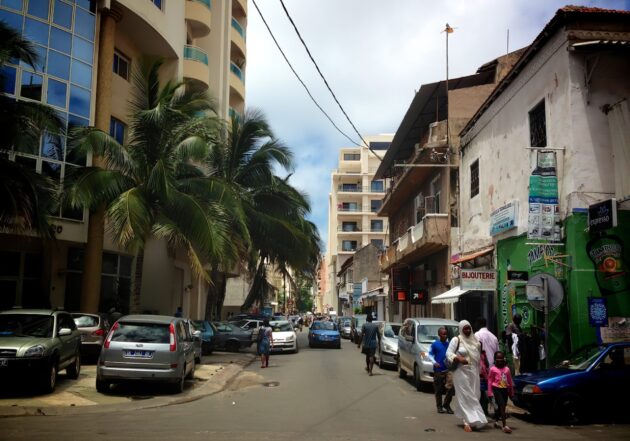
Visiting Senegal and its capital, Dakar: where to go to book accommodation in Dakar?
Former capital of French East Africa (AOF), Dakar is the capital of the Republic of Senegal, independent from France since 1960. A macrocephalic capital with significant demographic growth, it is home to half of the country’s urban population, within a conurbation of 1,056,009 inhabitants and 3.6 million inhabitants in the entire Dakar region (2018). Located at the western tip of Africa and the Cape Verde peninsula, Dakar has a recent history, dating back to the mid-19th century. Dakar is home to 25% of the country’s population and 80% of its economic activity. There are many livable neighborhoods to choose from in Dakar.
Indeed, the city of Dakar boasts many pleasant, peaceful and quiet residential areas, while the city center boasts a lively daytime and nightlife. Here’s our selection of neighborhoods to stay in Dakar.
Dakar-Plateau

The Dakar-Plateau district is the city’s oldest: it was here, on the southern corniche, that the first colonists settled. Colonial buildings can be found here, as well as those of the modern city center, with banks, multinationals and institutions, as well as beaches and museums (Ifan Museum, Senegalese Armed Forces Museum). Avenue Pompidou – formerly Avenue William Ponty – is the main avenue in the city center. Here, you can find all the clothes you want, especially at the Sandaga market, but in a deafening din of traffic jams.
At the far end is the Place de l’Indépendance, not far from the port of Dakar, where you’ll find everything you need: cafés, brasseries, fast-food outlets, pharmacies, craft stores, jewellers, post office, etc. Beware, however, as the area is very touristy and scams are legion. A walk to Cap Manuel is well worth the detour, for a peaceful stroll along the corniche (don’t linger there in the evening!).
Find a hotel in Dakar-Plateau
Find an Airbnb in Dakar-Plateau
The Medina

Photo credit: Wikimedia Commons – BENLASFAR
La Médina is the working-class district of authentic Dakar. Created by Governor William Ponty in 1914, it is one of the city’s most densely populated districts, with living standards rising steadily over time. You’ll find the Grand Mosque, the Soumbédioune market – a very touristy market – and souvenir stores. It’s an ideal area to stay in Dakar if you want to stay in a relatively central location, away from the hustle and bustle of the city center.
Find a hotel in La Medina
Find an Airbnb in La Médina
Grand Yoff

Photo credit: Wikimedia Commons – Ji-Elle
Grand Yoff is popular with Western tourists because it’s popular, picturesque and dynamic. Situated between the airport and the Hann Zoological Park, it’s a lively and vibrant area, with markets, restaurants, bars and nightclubs for partying. It’s also an ideal base for those wishing to travel to Casamance, Senegal’s famous southern region.
Find a hotel in Grand Yoff
Find an Airbnb in Grand Yoff
Goree Island

Photo credit: Flickr – hewy
Why miss this historic islet off the southern tip of Dakar? The island of Gorée is itself a commemoration of the slave trade: first colonized in 1444 by the Portuguese, it was taken by the Dutch in 1588, then by the French in 1677. Occupied by the English from 1804 to 1817, it was returned to France until Independence. Many colonial buildings can be found here, notably the Old Governor’s Palace. You can also visit the Musée de la Femme, the Maison des Esclaves and the Musée des Esclaves at the former Fort d’Estrées.
There aren’t many hotels to stay in Gorée, but it’s a must on any trip to Dakar, if only to remember the atrocities committed by the West against millions of black people over several centuries.
Find a hotel on Gorée Island
Find an Airbnb on Gorée Island
Map of hotels and accommodation – Dakar,sn